Blog

Splash Pad Rubber Surfacing in Dallas Fort Worth: How to Prevent Staining, Fading, and Premature Failure

DFW splash pad surfacing takes a beating. Heat. UV. Hard water. Landscaping runoff. Constant wetting. Chlorinated water and sanitizers running day after day.

DFW splash pad surfacing is not “just rubber.” It is a chemical environment, and the wrong system (or the right material installed the wrong way) can stain, fade, soften, or delaminate long before it should.

At Legendary Pools & Outdoor Living, we build and maintain high-standard outdoor environments across DFW, and we are expanding those standards into aquatic surfacing through Legendary Rubber Surfaces, a dedicated division focused on EPDM and specialty rubber systems.

This guide breaks down what actually causes splash pad rubber problems in North Texas, and what a stable, defensible EPDM system looks like.

Why Splash Pad Rubber Surfaces Fail in DFW

Most surface problems are not caused by “chlorine” as a simple concept. Failures come from stacked conditions that are common in Dallas, Fort Worth, Plano, Frisco, McKinney, Allen, Southlake, Westlake, Flower Mound, Coppell, Irving, Grapevine, and the surrounding cities.

1) Chemical extremes, especially low pH events

A short-term chemical controller failure or an aggressive manual dosing event can permanently discolor a surface, weaken binders, and degrade coatings.

2) Constant wetting plus oxidizers

Sanitizers do their job, but over time they can slowly stress the wrong binder system, especially when chemistry concentrates as water evaporates in 100 degree heat.

3) Metals in water, iron and copper

Many “mystery stains” in DFW are metals from source water, corrosion products, or nearby landscape elements. These can embed into porous traction surfaces.

4) Sunscreen oils and organic residue

Footprint smudges and dark patches are often sunscreen and body oils, especially around entry points and lounging edges.

5) Landscape runoff and irrigation overspray

Mulch tannins, fertilizer, and irrigation overspray are frequent stain sources, particularly at perimeters and low points.

6) Ponding and trapped moisture

If water stands on the surface after shutdown, staining risk jumps and long-term failure becomes more likely. Drainage is not optional.


The System That Stays Stable: EPDM Plus the Right Binder Plus a Barrier Topcoat

You will see major splash pad manufacturers and feature companies using rubber surfacing because it can perform very well when specified correctly. The key is treating the installation like a system, not a single material.

A stable splash pad spec includes:

1) True EPDM wear layer

Real EPDM granules with exterior-grade UV stable pigmentation and the right gradation for traction and durability.

2) Chemical and UV resistant polyurethane binder

Splash pads require a binder rated for outdoor UV exposure and continuous wet conditions. Many “standard” binders are fine for playgrounds, but are not the best choice for chlorinated splash pad environments.

3) Chemical barrier topcoat

This is one of the highest ROI upgrades for DFW splash pads.

A compatible chemical barrier topcoat helps:

  • Reduce surface porosity so contaminants do not embed as easily

  • Improve cleanability so routine maintenance actually works

  • Reduce staining from metals, oils, and organic residue

  • Reduce chemical contact with the binder and pigment system

If you want a surface that still looks like a premium facility years later, topcoat is often the difference maker.


Installation Details That Separate “Looks Good Today” From “Still Looks Good Later”

Splash pad surfacing success is won in the prep and detailing.

Drainage verification

We verify slope, drain function, and ponding risk before surfacing is installed. If the slab holds water, it should be corrected before EPDM goes down.

Penetrations and edges

Spray feature bases, anchors, sleeves, and drain transitions must be detailed to prevent water migration beneath the system. Edge restraint and sealed terminations matter.

Moisture spot testing for due diligence

In DFW, slabs can hold localized moisture near drains, shaded zones, or patched areas. We document substrate moisture spot testing prior to install as part of our QA records.

Cure protection

Even the best system can be compromised if the surface is put into service too soon or exposed to irrigation overspray, rain, or debris during cure.


Maintenance Truth: “Low Maintenance” Still Means Routine Cleaning

Even with a topcoat, EPDM splash pad surfacing is a traction surface. That means it will capture residue over time if it is not maintained.

A practical operating approach:

  • Routine rinsing and flushing during the season

  • Weekly light scrub with approved cleaners

  • Monthly full cleaning and inspection

  • No harsh solvents, no acids, no aggressive pressure washing at close range

If staining appears, the first move is documentation, not escalation. Strong chemicals and abrasive methods are the fastest way to turn a manageable stain into permanent surface damage.

If you manage a commercial facility, we can provide cleaning logs and stain incident forms so your team has a repeatable method and a clean paper trail.


Who This Is For in Dallas Fort Worth

Legendary Rubber Surfaces is built to support both new construction and rehabilitation for:

  • HOA and community splash pads

  • Apartment and multifamily amenities

  • Hotels, resorts, and private clubs

  • Municipal facilities and parks

  • Schools and child-focused facilities

  • Indoor aquatic spaces with wet traffic zones

If your facility is in DFW and the surface has to perform under real-world conditions, we can spec and install a system designed for that reality.

FAQs: Splash Pad Rubber Surfacing in DFW

Can rubber really hold up to chlorinated water long-term?

Yes, when the EPDM, binder, and topcoat are selected as a compatible system designed for continuous wet aquatic exposure. Most problems come from incomplete systems or chemistry extremes.

Why do some splash pad surfaces stain so quickly?

Most staining comes from metals (iron/copper), sunscreen oils, organics, runoff, or ponding. A barrier topcoat and correct maintenance reduce this significantly.

Is a topcoat worth it in North Texas?

In DFW heat and UV, topcoat is often one of the best upgrades. It improves cleanability and stain resistance, and helps preserve finish and color.

What is the biggest installation mistake?

Poor drainage and weak detailing at penetrations and edges. Ponding and under-system moisture migration are common roots of early failure.


Ready to Build a Splash Pad Surface That Holds Up in DFW?

If you are planning a new splash pad, resurfacing an existing pad, or dealing with staining and wear, we can help you choose a system that fits your facility and your budget without gambling the finish.

Contact Legendary Pools & Outdoor Living to schedule a consultation, or request a splash pad surfacing specification package through our Legendary Rubber Surfaces division.

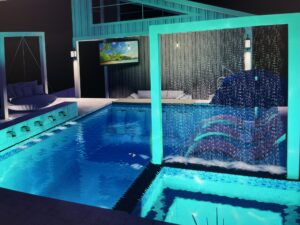
Pool Rainfall Features Done Right

A pool rainfall feature can transform the atmosphere of an outdoor living space. When we design it correctly, rainfall becomes more than water. It becomes sound, light, movement, and the feeling of a space coming alive. However, rainfall is also one of the easiest features to do almost right. It can look great in photos, yet underwhelm in real life.

If you are considering a rainfall feature for a high-end pool or outdoor living space, here is what matters most so the finished result feels intentional, immersive, and timeless.

What a Rainfall Feature Really Is

A rainfall feature creates a controlled sheet or field of water that falls in a consistent pattern across a specific width. In most luxury builds, builders mount it overhead, integrate it into an architectural beam, or conceal it inside a clean modern profile.

In a high-end environment, the goal usually includes one or more of the following:

  • A calming, natural rain sound without harsh splashing

  • A visually clean rain line that reads well day and night

  • A dramatic nighttime moment with integrated lighting

  • A feature that feels built into the architecture, not added later

With that in mind, here are the four details that separate a nice rain feature from a legendary one.

The Four Details That Separate Nice From Legendary

1) Flow Control: The Difference Between Drizzle and Rain

Rainfall depends on volume and distribution. For example, when the feature does not receive enough flow, it turns into a thin trickle that reads like a leaky edge, not rain.

The key is not just “enough flow.” You want controlled flow you can repeat. In high-end builds, modern variable speed pumps and automation presets give you that control.

Instead of pinching a line with a valve to force the look, we prefer controlling rainfall intensity through programmed pump presets. As a result, you get repeatable results at the touch of a button, and you avoid unnecessary back pressure on the system.

A proper rainfall system should include:

  • A dedicated water feature line

  • A properly sized variable speed pump, plus plumbing sized to match

  • Automation presets for specific rainfall moods, such as:

    • Soft Rain

    • Evening Rain

    • Full Rain Moment

Valves still matter. However, use them mainly for routing and isolating features, such as rain versus bubblers, service shutoffs, and seasonal control. Let the pump handle the fine tuning.

What to ask your builder:
Are we controlling the rainfall effect with pump presets, or are we relying on valves to throttle the flow?

2) Sound Design: Where Rain Feels Expensive

Sound makes up half the experience. Most homeowners do not realize that luxury sound happens by design, not by accident.

Several choices shape the sound:

  • Drop height, because higher is not always better

  • What the rain hits, such as water surface, stone, or a hidden catch basin

  • Consistency across the full width

  • Wind exposure, which makes placement critical

If you want rainfall that feels refined, not chaotic, you must plan where the water lands and shape that landing zone intentionally.

What to ask your builder:
Where will the water land, and how will we control splash and sound?

3) Lighting: Built-In Illumination vs A Light Pointed at It

If you want the rainfall feature to come alive at night, integrated lighting changes everything. There is a big difference between:

  • A nearby light aimed at the rain, which often looks uneven and weak

  • Integrated lighting that illuminates the falling water itself

When you integrate lighting correctly, the rain becomes a glowing veil. In addition, it stays visible, dimensional, and cinematic from the right viewpoints.

What to ask your builder:
Is the lighting integrated into the rainfall feature, or are we just lighting it from nearby?

4) Architecture Integration: The Cleanest Luxury Look

The best rainfall features look like they belong to the home. To get that result, you need:

  • Clean concealment of plumbing and wiring

  • Structure designed to support the feature from day one

  • A finish strategy that matches surrounding materials, such as tile, stone, metal, plaster, or modern cladding

A rainfall feature should never look bolted on. Instead, it should feel inevitable, like it was always part of the plan.

What to ask your builder:
Where will you hide the plumbing, and what will the finished detail look like from every angle?

Common Mistakes That Cost the Most Later

Rainfall features disappoint for a few predictable reasons:

  • Undersized plumbing that cannot deliver the desired flow

  • No dedicated feature pump, which causes the pool system to suffer when rainfall runs

  • Using throttling valves as the primary control, which adds back pressure and creates inconsistency

  • Lighting added as an afterthought, instead of integrated into the feature

  • Wind exposed placement, which causes spray and uneven performance

  • No splash strategy, which leads to wet decking and constant cleanup

Luxury should feel effortless. That only happens when you design the feature as a complete system.

Our Philosophy: Build It So You Can Tune It

A properly engineered rainfall feature should give you control. The best installations let you fine tune:

  • Intensity through automation presets

  • Sound by shaping the landing zone

  • Lighting mood through integrated illumination

  • Interactions with other features, such as bubblers and spa spillways

It should feel like a signature moment when you want it, and it should disappear into the architecture when you do not.

Quick Checklist for Homeowners

Before you commit, get clear answers to these:

  • Is there a dedicated variable speed pump for rainfall and other features?

  • What plumbing size will deliver the desired flow?

  • Do we have automation presets for multiple rainfall intensities?

  • Where does the water land, and how do we control splash?

  • Is the lighting integrated into the rainfall feature itself?

  • How will you conceal plumbing and wiring in the final finish?

Closing

If you are building a pool and outdoor living space at a high level, your rainfall feature should meet that same standard. The goal is not just a feature. It is an experience, engineered with intention.

If you would like, we can help you design a rainfall feature that feels clean, controlled, and truly elevated, day and night, with presets that let you choose the exact mood you want at the touch of a button.

Blog Post Title

What goes into a blog post? Helpful, industry-specific content that: 1) gives readers a useful takeaway, and 2) shows you’re an industry expert.

Use your company’s blog posts to opine on current industry topics, humanize your company, and show how your products and services can help people.